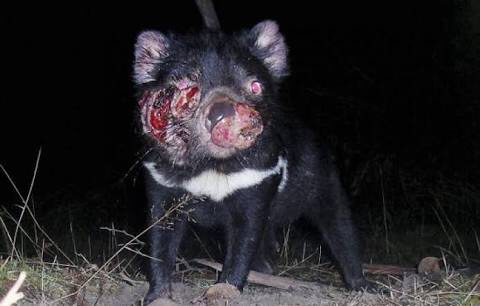
The Tasmanian devil (Sarcophilus harrisii, referred to as the devil hereinafter), the world’s largest living carnivorous marsupial, is currently at risk of extinction in the wild due to an unusual transmissible cancer known as Devil Facial Tumour Disease (DFTD)1. DFTD is caused by a clonal tumour cell line that originated in a Schwann cell2. Tumour cells are transmitted between individuals as allografts via biting3, and diseased animals usually die within 6 months4. Despite having a typical mammalian immune system which is capable of allograft rejection5,6,7, most devils produce no allogeneic response against the foreign tumour cells, with naturally occurring anti-DFTD responses having only been observed in six animals so far8. Such lack of immune response has thus far been explained by the fact that DFTD cells downregulate their cell surface expression of the major histocompatibility complex (MHC) class I molecules through epigenetic regulation9. However, MHC I downregulation is one of the most common mechanisms of tumour immune escape in human cancers10,11, yet there has been no indication that such cancers can cross histo-incompatibility barriers. Therefore, it is likely that DFTD uses additional immune evasion mechanisms to be so remarkably contagious.
The hypothesis that we explored in this study arose from the observation that DFTD does not affect devils of different age classes equally. Devils have an average lifespan of 5–6 years. Females become reproductively mature at the age of 1 and males at the age of 2 years12. At DFTD-affected sites, devils older than 3 years of age are rare (<10%, with certain populations containing only animals <3 years of age), and the level of disease prevalence is higher in older devils than that in younger animals13. Interestingly, animals less than 1-year-old are rarely affected by DFTD1, and diseased mothers do not transmit DFTD to their young14. Such age-associated difference in disease prevalence led us to hypothesise that the decline of overall immune competence in an individual, either due to ageing or other factors, could play a role in causing susceptibility to DFTD.
To perform a comprehensive characterisation of immunosenescence in the devil and explore its role in DFTD, we analysed the T-cell repertoire diversity of devils. T cells are the main effector cells responsible for the immune surveillance of infections and tumours. T-cell repertoire diversity, which decreases with age as immunosenescence advances, is a key indicator of the capacity of an animal’s immune system to respond to diseases
 super single moms
WOW!
LikeLike