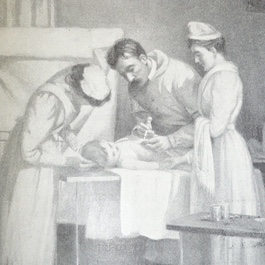
A person may become immune to a specific disease in several ways. For some illnesses, such as measles and chickenpox, having the disease usually leads to lifelong immunity to it. Vaccination is another way to become immune to a disease. Both ways of gaining immunity, either from having an illness or from vaccination, are examples of active immunity. Active immunity results when a person’s immune system works to produce antibodies and activate other immune cells to certain pathogens. If the person encounters that pathogen again, long-lasting immune cells specific to it will already be primed to fight it.
A different type of immunity, called passive immunity, results when a person is given someone else’s antibodies. When these antibodies are introduced into the person’s body, the “loaned” antibodies help prevent or fight certain infectious diseases. The protection offered by passive immunization is short-lived, usually lasting only a few weeks or months. But it helps protect right away.
Passive Immunity: Natural vs. Artificial
Natural Infants benefit from passive immunity acquired when their mothers’ antibodies and pathogen-fighting white cells cross the placenta to reach the developing children, especially in the third trimester. A substance called colostrum, which an infant receives during nursing sessions in the first days after birth and before the mother begins producing “true” breast milk, is rich in antibodies and provides protection for the infant. Breast milk, though not as rich in protective components as colostrum, also contains antibodies that pass to the nursing infant. This protection provided by the mother, however, is short-lived. During the first few months of life, maternal antibody levels in the infant fall, and protection fades by about six months of age.
Artificial Passive immunity can be induced artificially when antibodies are given as a medication to a nonimmune individual. These antibodies may come from the pooled and purified blood products of immune people or from non-human immune animals, such as horses. In fact, the earliest antibody-containing preparations used against infectious diseases came from horses, sheep, and rabbits.
The History of Passive Immunization
Antibodies were first used to treat disease in the late 19th century as the field of bacteriology was emerging. The first success story involved diphtheria, a dangerous disease that obstructs the throat and airway of those who contract it.
In 1890, Shibasaburo Kitasato (1852-1931) and Emil von Behring (1854-1917) immunized guinea pigs against diphtheria with heat-treated blood products from animals that had recovered from the disease. The preparations contained antibodies to the diphtheria toxin that protected the guinea pigs if they were exposed soon thereafter to lethal doses of diphtheria bacteria and its toxin. Next, the scientists showed that they could cure diphtheria in an animal by injecting it with the blood products of an immunized animal. They soon moved to testing the approach on humans and were able to show that blood products from immunized animals could treat diphtheria in humans. The antibody-containing blood-derived substance was called diphtheria antitoxin, and public boards of health and commercial enterprises began producing and distributing it from 1895 onward. Kitasato, von Behring, and other scientists then devoted their attention to treatment of tetanus, smallpox, and bubonic plague with antibody-containing blood products.
The use of antibodies to treat specific diseases led to attempts to develop immunizations against the diseases. Joseph Stokes Jr, MD, and John Neefe, MD, conducted trials at the University of Pennsylvania under contract to the US Navy during World War II to investigate the use of antibody preparations to prevent infectious hepatitis (what we now call hepatitis A). Their pioneering work, along with advances in the separation of the antibody-containing blood component, led to many studies on the effectiveness of antibody preparations for immunization against measles and infectious hepatitis.
Before the polio vaccine was licensed, health officials had hopes for the use of gamma globulin (an antibody-containing blood product) to prevent the disease. William M. Hammon, MD, of the University of Pittsburgh Graduate School of Public Health, building on Stokes’s and Neefe’s work, conducted important trials to test this idea in 1951-52. He showed that administration of gamma globulin containing known poliovirus antibodies could prevent cases of paralytic polio. However, the limited availability of gamma globulin, and the short-term protection it offered, meant that the treatment could not be used on a wide scale. The licensure of the inactivated Salk polio vaccine in 1955 made reliance on gamma globulin for poliovirus immunization unnecessary.
Passive Immunization Today
Today, patients may be treated with antibodies when they are ill with diphtheria or cytomegalovirus. Or, antibody treatment may be used as a preventive measure after exposure to a pathogen to try to stop illness from developing (such as with respiratory syncytial virus [RSV], measles, tetanus, hepatitis A, hepatitis B, rabies, or chickenpox). Antibody treatment may not be used for routine cases of these diseases, but it may be beneficial to high-risk individuals, such as people with immune system deficiencies.
 super single moms